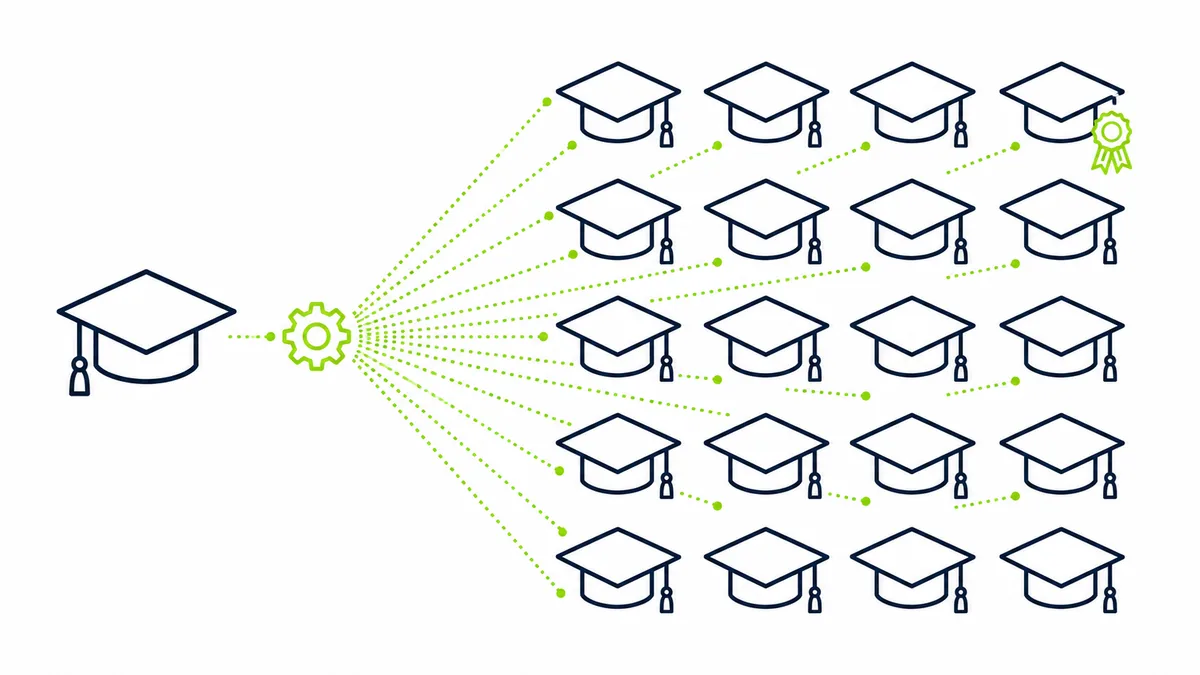
How do I scale partner certification and training without adding headcount?
You scale partner certification without new headcount. You redesign the system architecture. Enrollment, reminders, approvals, and CRM sync run automatically. Most programs rely on manual chasing. The failure sits in tools and workflow logic. The failure does not sit in content quality or trainer effort.
The manual certification process that works at 15 partners breaks somewhere between 40 and 60 — and most portcos don't notice until Q3 forecast slips
Your manual process does not crack at 200 partners. It breaks around 40 to 60. That is the point where one enablement manager cannot track who enrolled, stalled, or expired.
You describe the symptoms as “enablement bandwidth.” The real problem is the system design. You have a person acting as a router instead of software logic. This prevents you from building scalable partner operations across your broader partner ecosystems.
Look at the workflow today:
- Someone uploads a list.
- Someone invites partners.
- Someone sends reminders.
- Someone checks assessment links.
- Someone updates the CRM.
Every step multiplies errors. Manual processes drive 8 to 12 percent error rates in B2B operations. These scale with volume, according to Zoey. You did not design this for 100 partners. You inherited a pilot process. It never contemplated formal partner training as volume increased.
Impact reports 43 percent of partnership managers say. Their team size cannot handle workload. Due to manual tasks Impact. Your portco probably sits in that group. Partner teams drown in coordination work. They focus on revenue. They focus on customer success outcomes.
At 15 partners, the gaps stay invisible. At 50, stalled certifications translate to delayed pipeline. You feel it as Q3 softness, not missed reminder logic, or low training completion across your partner base.
You do not need more coordinators. You need a system. It treats certification like an automated learner journey. From invite to badge. Without human babysitting.
The partner rep who hasn't cleared certification won't carry your solution on customer calls — and their manager stopped following up in week three
Your revenue problem sits inside each partner rep’s calendar. Not inside the enablement dashboard. A rep who has not cleared certification will not risk your unfamiliar SKU on a live deal. Especially if their sales team already has easier products. They know how to position them.
The partner manager stops chasing by week three. Their quota pushes them toward products that feel easier. Your solution slides to the bench. Even if it could improve customer success metrics for shared accounts.
TSIA notes partners end up “certified but unequipped” for real delivery. This happens on AI solutions TSIA. In your case, you also have the opposite. Unequipped and uncertified.
The friction looks like this:
- Rep never received an auto invite.
- Or they received it once and lost the link.
- Or they started, got interrupted, and never saw another reminder.
- Or their manager has no dashboard of team progress.
- Or your team holds office hours at impossible times.
You think “low engagement.” The rep experiences “path of least resistance.” They sell what they understand. Their manager checks. Not what your partner ecosystems would prefer to promote.
Manual programs also slow assessments. Staff-led evaluations create weeks of lag. This kills momentum, according to BongoLearn. During those weeks, the rep still avoids your product. Your deal registration numbers stay lower than modeled.
Until you fix rep-level friction with automated paths. And status visibility, every forecasted dollar from “enabled” partners rests on hope.
When half your partner reps haven't completed certification, the ARR they're supposed to carry is a pipeline assumption you'll need to defend at the next board meeting
Board exposure does not start when partners miss targets. It starts when you count uncertified reps as productive capacity. If half the partner reps have not finished certification, half the modeled ARR is fiction.
If a certified partner drives $500K in annual partner-sourced revenue, a three-month certification delay forgoes roughly $125K per partner (BongoLearn's illustration). Spread across 50 partners, that delay reaches 6.25 million dollars. That number sits inside your Q3 and Q4 plan.
You cannot answer three basic questions today:
- How many reps inside each partner are certified?
- What ARR target attaches to those specific reps?
- Which deals in pipeline belong to uncertified sellers?
Most portcos log completion in the LMS and revenue in the CRM. They never connect the two. Introw notes that training programs lack any direct tie to pipeline. This obscures readiness Introw. That gap shows up as “missed partner number” in the board deck. It hides weak completion rates. They undermine your certified partners strategy.
The board will not accept “partners underperformed” as explanation. You own the infrastructure that certified, measured, and greenlit those partners as capable of delivering on customer success and ARR expectations.
Until you treat certification status as an operational control. Not a vanity metric. Every plan assumes partner ARR creates the exact flaw. You fear the board will find in his portco.
If your certification program has never completed a cohort without someone manually chasing completions, you don't have a scaling problem — you have a program design problem
You can run one simple diagnostic in a week. Look at your last three partner certification cohorts. Ask a single question: did any cohort finish without a human chasing completions?
Chasing includes:
- Manual reminder emails.
- One-off Slack or WhatsApp nudges.
- Calendar invites for “makeup” sessions.
- Managers asked to “nag their teams.”
If you always see manual chasing, you face design failure. Not temporary resourcing. LearnWorlds shows fragmented systems for registration, learning, and certification status make scale impossible LearnWorlds. Human glue hides structural cracks and traps your training business in a scaling trap.
A program that can scale has:
- Automatic enrollment tied to CRM or partner portal events.
- Rule based reminders that escalate to managers.
- Self service scheduling, or asynchronous assessments.
- Auto issuance of credentials, then CRM sync.
BongoLearn highlights manual enrollment, tracking, and assessment form the primary bottleneck to scale BongoLearn. Until you redesign around automation, any new hire just becomes a faster chaser.
You should reserve headcount for program strategy and partner development. If daily operations depend on a hero coordinator, you have created single point risk. The board believes this exact area scales cleanly.
Treat “no manual chasing” as a hard requirement. If your program cannot pass that test, you need a ground-up rebuild. Not incremental tweaks.
The LMS your portco is using for partner certification was built for employee compliance training — it has no logic for self-managing a tiered channel program
Most portcos force a compliance LMS into channel duty. That tool was built for HR, not for a tiered, external partner ecosystem.
Compliance LMS design assumptions:
- Have an internal directory.
- Mandate training.
- Enforce deadlines.
- Stay static.
- Attach no revenue target to each course.
Partner programs break every assumption. Partner rosters shift weekly. New reps appear with no IT ticket. Tiers change. Programs require different tracks by role, region, and specialization.
LearnWorlds documents that multiple disconnected systems create friction. Registration, learning, and status systems create tracking errors LearnWorlds. An HR LMS never solved that problem. It never needed to.
Introw points out modern partner certification depends on CRM integration. CRM integration provides real-time readiness views Introw. Most employee LMS platforms treat CRM as an afterthought. They support it, if they support it.
You feel the gap when you ask simple channel questions:
- Which gold partners lost their technical specialist?
- Which partner can attach to this AI deal tomorrow?
- Which distributor has at least three certified reps live now?
If your LMS cannot answer those questions instantly, your architecture blocks a self-running program that could scale customer impact across markets.
You can keep adding coordinators to bridge systems. You will not get scale without a purpose-built partner certification platform. It behaves like a scalable partner engine for your partner ecosystems.
When you start the fix, the team will want to rebuild course content — but certification content is almost never the bottleneck; enrollment logic, completion triggers, and approval handoffs are
Your team will push to rewrite decks and record better videos. Content feels safe and familiar. It also rarely solves the true bottleneck.
Josh Bersin reports that 74 percent of companies cannot keep pace. This drives investment in AI powered, adaptive learning. Not just prettier content Josh Bersin. Your partners need targeted paths. They do not need another static slide library.
The real friction appears in:
- Enrollment logic: who gets what track, based on role and tier.
- Completion triggers: what counts as “certified” and when it expires.
- Approval handoffs: who validates practical readiness and in which system.
- Notifications: who hears about expirations, new versions, or failures.
BongoLearn stresses scheduled, staff-led assessments delay progress. They make partners drop, irrespective of content quality BongoLearn. Process timing kills energy.
You can improve certification throughput quickly if you:
- Automate track assignment from CRM partner data.
- Use rule based reminders that escalate intelligently.
- Replace live assessments with asynchronous, auto scored tasks.
- Let managers see live progress without asking your team.
TSIA links AI powered training. It adapts to skill gaps. It strengthens partner led XaaS revenue TSIA. That requires smart orchestration. Not just polished videos.
Direct your first 30 days toward journey logic and system connections. You can refresh content later, once you know the machine runs. Your training completion data accurately reflects real readiness.
Separating certification delivery from certification management is the prerequisite for running the program without a dedicated coordinator
You will not escape headcount until you separate delivery from management. Delivery means hosting and serving content. Management means deciding who takes what, when, and why it matters.
Today, people do both: a coordinator enrolls users, fixes lists, explains tracks, nudges people who are behind, and sometimes runs sessions, sitting between every partner and your program, which keeps your training businesses from getting the full benefit of their work.
The scalable model looks different:
- Certification management logic lives in software.
- Certification delivery uses whatever learning front end works best.
- Your team only designs programs and builds relationships.
Impact shows automation frees teams to focus on growth plays. These include campaigns and new markets Impact. That shift only happens when tools handle routine operations. They do this for your internal sales team. They also do this for external partner teams.
A clean separation gives you:
- Automated eligibility rules per partner tier and role.
- Automatic progression paths across levels.
- Clear ownership of exceptions and appeals.
- Infrastructure that supports global scale without more admins.
Hyperbound describes a closed-loop skill development model. AI watches performance. AI assigns practice. AI measures improvement across large groups Hyperbound. You can only connect that to your partners. Management moves through APIs, not spreadsheets.
Make “no human required for standard paths” your design constraint. Once the system can enroll, route, and certify on its own. You can decide whether a coordinator adds value, rather than patches holes. You avoid the scaling trap that eats margin in every training business.
Platforms built for external partner certification — like Cypher Learning — are designed around the assumption that no one from your team will be manually advancing partners through the program
Purpose-built partner certification platforms start with a different premise. They assume your team will not manually move partners through steps. Tools like Cypher Learning and other partner-focused systems from source cypher learning embed automation. At every layer.
Key differences versus employee LMS tools:
| Capability | Compliance LMS | Partner certification platform |
|---|---|---|
| Primary audience | Internal employees | External partners and tiers |
| Enrollment | Manual or HR feed | Rules based from CRM or partner portal |
| Progress reminders | Generic emails | Automated, role aware, with escalation |
| Certification rules | Single track, static | Multi tier, role based, with expirations |
| CRM integration | Basic or none | Deep, for readiness and pipeline connection |
Introw notes that CRM synced certification systems are becoming standard. They give real time views of readiness and revenue impact Introw. That turns your program into an operational control surface. Not a side database.
Impact’s research shows partnership automation lets lean teams scale programs Impact. Without linear headcount growth. That same logic applies to certification workloads. It applies to how you scale customer outcomes across multiple partner ecosystems.
When you evaluate platforms, use these filters:
- Does it automate enrollment, assessment, and feedback, or need admins BongoLearn?
- Can it adapt paths to skill gaps with AI, as TSIA recommends TSIA?
- Can it support global languages and time zones without more staff Hyperbound?
If your current stack fails those tests, you do not have a training problem. You have infrastructure that will cost you another quarter. It will block you from becoming a truly scalable partner organization.
Frequently Asked Questions
Q: Why does my partner certification program feel fine at 15 partners but fall apart around 40 to 60? Your program breaks around 40 to 60 partners because one enablement manager can no longer keep track of who enrolled, stalled, or expired. Every manual step in your workflow increases the chance of mistakes. Those mistakes grow as volume rises. You see the effect as Q3 softness and “enablement bandwidth” issues. The real cause is a system designed for a pilot, not for scale.
Q: What is actually blocking partner reps from getting certified and selling my product? Your revenue problem sits in each partner rep’s calendar. Not in your dashboards. Reps miss or lose invites. They get interrupted without follow up reminders. They lack manager visibility. Or face office hours at impossible times. Manual, staff-led assessments add weeks of delay. Reps avoid your product. They default to what feels easier. They default to what feels better monitored.
Q: How does incomplete certification turn into a board-level risk for my ARR forecast? When you count uncertified reps as productive, you inflate capacity. You create fictional ARR in your plan. You cannot answer how many reps are truly certified. You cannot answer what ARR target attaches to those specific reps. You cannot answer which deals sit with uncertified sellers. Portcos never connect LMS completion data to CRM revenue. The gap shows up as a “missed partner number.” The board will challenge it.
Q: How can I tell if I have a scaling problem or a program design problem? Look at your last three certification cohorts and ask whether any finished without humans manually chasing completions. If the answer is no, you have a design failure, not a temporary resourcing gap. Manual nudges, fragmented systems, and “hero coordinator” behavior are signs your architecture cannot scale. It needs a ground-up rebuild.
Q: Why is my existing LMS struggling for partner certification? What should the architecture look like instead? Your LMS was likely built for internal compliance training. Users are static. Training is mandated. No revenue target attaches to courses. Partner programs break those assumptions. They have constantly changing rosters, tiers, and roles. They also need CRM-linked readiness. You need an architecture where certification management logic lives in software. It integrates deeply with CRM. It treats “no human required for standard paths” as a hard design constraint. That architecture should also support partner training, video assessment options, and clear learning paths. So training completion is predictable rather than ad hoc.
Q: Should I focus first on improving training content or fixing the workflow and tools? You should fix enrollment logic, completion triggers, and approval handoffs before changing training content. Rewriting decks and recording new videos will not solve bottlenecks caused by manual enrollment, staff-led assessments, and poor notification rules. Once automated paths, rule-based reminders, and CRM-driven track assignments are in place, content updates can actually improve throughput and readiness.
Your problem is system architecture, not trainer effort. Fix the certification engine once, in one portco. You protect forecast credibility across the portfolio. If you want a partner that can redesign that engine. Talk to Cortado Group. This is how you align certified partners, deal registration flows, partner teams, and your internal sales team. All around a single training business model. That actually scales.
See how Channel Partner Enablement OS turns this into a guided workflow your reps actually use.
Sign in to your workspace →See where your own channel program stands. Take our channel assessment: 13 questions, four scores (Foundational, Enablement, Revenue Ops & Attribution, Management), one read on where the leak actually is.
Take our channel assessment →