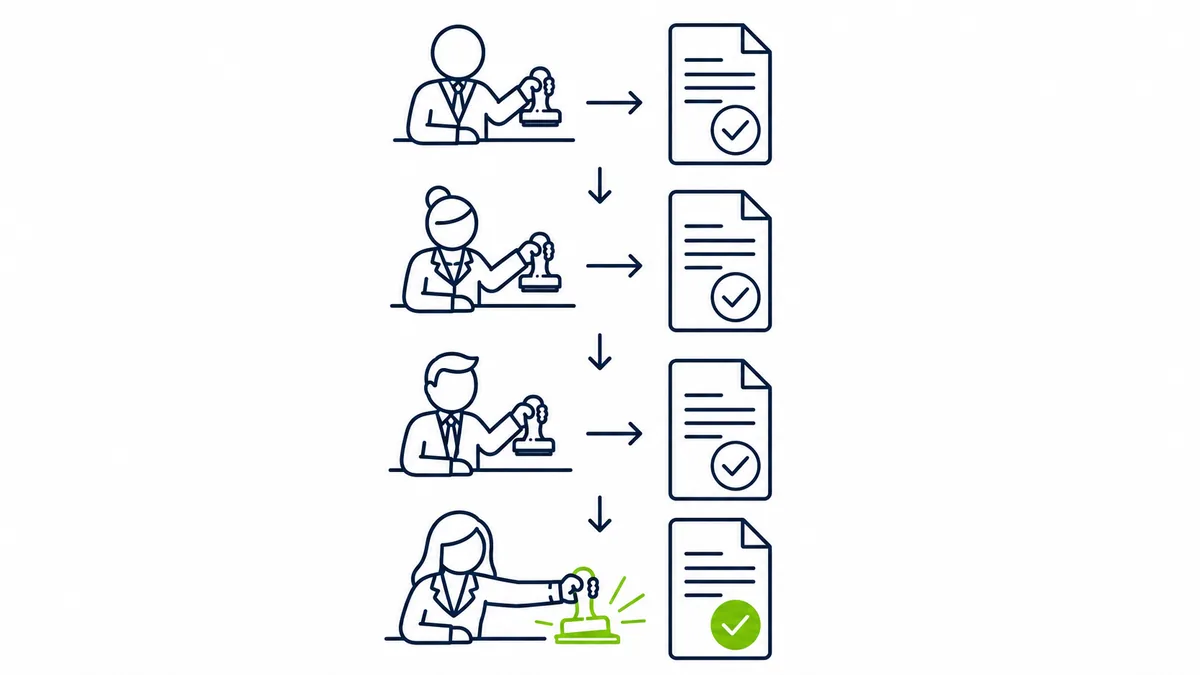
Who actually needs to sign off before we buy AI tools for our partner ecosystem?
AI tools go dark in partner ecosystems when the person who signs the contract doesn't own the partner attach number
You need sign-off from every major function: procurement, executive sponsor, partner GTM owner, compliance, IT, and legal. If only procurement teams face the pressure to approve, you will miss the real risk. Someone else owns the partner attach number. If no one has clear GTM accountability, that becomes your career risk. A bad deal can cost your job. If the partner leader did not approve, later success stays invisible. Tool adoption stalls, ROI tanks, and LPs ask questions you cannot answer.
Most partner ecosystem AI projects fail for the same reasons:
- You skip line-of-business approval.
- You rely on procurement alone.
- You assume "aligned" in meetings equals documented, formal buy-in.
- No one owns the hard partner metrics.
- You cannot show risk guardrails with live proof.
AlixPartners: Formal approval from all key stakeholders is needed before tool rollout. Organizations where most projects have actively engaged executive sponsors report 40 percent more successful projects, per PMI's Pulse of the Profession. 86 percent of surveyed executives, employees, and educators blame workplace failures on lack of collaboration or ineffective communication, per a Fierce Inc. survey of about 1,400 respondents. Only about 20 percent of organizations involve teams in setting their goals, but co-created goals unlock adoption, per Gartner (via SpendHQ). Forrester: 60% plan to invest in AI-driven partner marketing tools — so the governance gap grows.
| Who Signs | What They Control | Risk if Missing |
|---|---|---|
| Procurement | Budget, Vendor Risk | Compliance exposure |
| Legal | Contract, Data | Lawsuit, breach risk |
| IT | Integration, Security | Data leaks |
| Partner GTM Lead | Attach Metric | No ROI, slow adoption |
| Executive Sponsor | Priority | No pull, orphan tool |
If you want answers you can defend to your Board, tie every AI tool contract to the partner metric owner. If not, you end up owning ROI you cannot deliver.
Procurement teams face a sign-off vacuum when RevOps, IT, and the channel chief each control the AI tool budget but none owns the partner GTM result
Procurement teams face growing confusion when each function has funding, but not accountability for partner GTM outcomes. AI platform investments for partner ecosystems now require buy-in across departments. 60% of organizations are planning to buy partner marketing automation with AI within a year, according to Forrester. Yet, RevOps, IT, and your channel chief rarely align on who owns which results. Each holds budget authority, but misses business ownership.
You need every key sign-off before selecting an AI tool. AlixPartners emphasizes deployment should not begin without a socialized, approved roadmap by all functions. Only about 20 percent of organizations involve teams in setting their goals, but goal co-creation directly boosts alignment and buy-in, per Gartner. Yet 86 percent of surveyed executives, employees, and educators blame workplace failures on lack of collaboration or ineffective communication, per a Fierce Inc. survey of about 1,400 respondents.
If you sense this vacuum, watch for these warning signs:
- Locking in budget decisions before anyone defines the GTM result
- Signing the AI tool contract by the channel chief, with RevOps controlling the use case
- Agreeing to fund by IT, without having any KPIs aligned to your channel
When does misalignment create risk for you?
| Department | Controls Budget | Required in Sign-Off? | Owns GTM Result? |
|---|---|---|---|
| RevOps | Sometimes | Yes | Rarely |
| IT | Often | Yes | No |
| Channel | Yes | Yes | Yes, shared/out-of-scope |
Aligning contract authority to outcome accountability is crucial. Procurement teams face growing urgency to end the sign-off vacuum. Formalizing both buy-in and accountability up front helps you avoid these pitfalls.
Every quarter the sign-off stays ambiguous, the AI tool's partner attach data becomes harder to defend at the LP level
Ambiguous decision rights create hidden risk inside your forecasts. You must defend attach rate, adoption, and impact at the board table. If sign-off stays unclear, each update introduces new LP exposure.
You can quantify the risk with real benchmarks:
- Reporting 40 percent more successful projects at organizations where executive sponsors actively engage (PMI)
- Blaming workplace failures on lack of collaboration or ineffective communication by 86 percent of surveyed executives, employees, and educators (Fierce Inc.)
- Leaving teams out of goal setting at roughly 80 percent of organizations, despite increased buy-in from co-creation (Gartner)
- Requiring formalized AI tool sign-off by every key group before deployment
- Using shared risk models to tie accountability to each signatory, including vendor and buyer
Compare your real-world scenario:
| Scenario | Q2 LP Exposure | Data Defensibility | Forecast Risk |
|---|---|---|---|
| Formal, unanimous sign-off | Low | High | Manageable |
| Key sponsors absent or unclear | High | Weak | Severe |
| No documented approval process | Extreme | Eroded | Existential |
Break ambiguous sign-off into known costs:
- Lower internal adoption
- Slower partner onboarding
- Fewer statistically valid case studies
- Higher risk disclosures
- More frequent executive review cycles
Calculate the forecast impact:
- Determining the percentage of partner growth that relies on timely AI adoption
- Identifying the metric that would need to be defended, line by line, with an LP
- Locating where every approval gap multiplies your data risk
You inherit every ambiguity as LP cost if you delay formal sign-off.
The channel chief measures attach-rate lift in quarters; finance applies a multi-year ROI horizon borrowed from direct-sales tooling — and that structural mismatch is what makes partner ecosystem AI sign-offs stall where CRM or security purchases don't
Channel AI procurement hits a roadblock because two core signers use different clocks.
Your channel chief expects results inside three to six months.
- Measuring attach-rate lift as the primary metric
- Assessing program success each quarter
- Missing your target one quarter and risking cancellation of the next initiative
- Wanting tools that show fast, partner-facing impact
- Securing executive sponsorship before launch to avoid sunk costs (SpendHQ)
Finance, in contrast, uses direct-sales tooling as a reference.
- Calculating ROI over a period of three or more years
- Fitting attribution frameworks to direct software sales or CRM rollouts
- Tracking metrics for bookings rather than multi-partner campaign velocity
- Focusing risk tolerances on evergreen platforms instead of experimental ecosystem pilots
- Using multi-year ROI whitepapers to drive decision-making (AlixPartners)
The result: a built-in sign-off delay that does not exist in mainstream IT buys.
| Evaluation axis | Channel chief (ecosystem tools) | Finance (direct-sales tools) |
|---|---|---|
| Success window | 1-2 quarters | 2-3 years |
| Core KPI | Partner attach-rate | Direct attribution ROI |
| Risk lens | Partner disengagement | Platform redundancy |
| Approval narrative | Fast lift, frontline impact | Future cash flows, asset utilization |
This horizon mismatch is not "stakeholder misalignment." It is a structural barrier. Attach-rate lifts emerge fast, fade fast, and rarely fit multi-year ROI molds. Finance leaders systematically undercount the value of quarterly partner acceleration (Forrester). Your roadmap can stall as finance waits for proof across a timeframe the channel cannot accept.
You cannot bridge this gap with another meeting or co-signature. You must make the horizon mismatch explicit.
Research shows buy-in only materializes once every key group sees its risk and reward defined on its terms (SpendHQ). In AI for channel, that means quantifying value and justification on partner timelines, not imported CRM or cybersecurity models (Gartner).
Lock the partner GTM accountability matrix before the AI tool contract goes to procurement — not after
Without formal accountability sign-off, you cannot measure or defend performance. Only about 20 percent of organizations involve teams in setting their goals, yet co-creation improves buy-in, per Gartner. If you delay socializing targets, you risk project stall or failure. AlixPartners stresses: secure written approval from all key groups before rollout.
Set your accountability matrix early. Define decision-makers, risk owners, and execution leads. 86 percent of surveyed executives, employees, and educators blame workplace failures on lack of collaboration or ineffective communication, per a Fierce Inc. survey of about 1,400 respondents. Assign clear KPIs per function before contracts advance.
Involve these groups in every pre-procurement step:
- Leading procurement
- Sponsoring executives
- Overseeing legal and compliance
- Architecting IT
- Heading line-of-business
- Owning partner accounts
Require signatures on three items before you move to procurement:
- Documented goals that connect to partner performance
- Assigned roles and measurable KPIs for each function
- Shared risk and escalation plan, signed by leaders
About 60% of partner marketing teams plan to buy AI within 12 months (Forrester). Rushing contracts without consensus means you inherit risk alone. The NIST framework warns: AI risk is shared by every group across the vendor and buyer organizations.
| Step | With Early Matrix | Without Matrix |
|---|---|---|
| Goal Visibility | Clear and tracked | Ambiguous and siloed |
| Procurement Speed | Accelerated with fewer disputes | Blocked by late goal confusion |
| Executive Confidence | High due to pre-set guardrails | Low due to missing accountability |
For AI, demands are rising. Enterprise buyers now require live proof of risk guardrails before sign-off (EY). Make every approval count, in writing.
How to run the approval sequence when partner channel success metrics aren't defined before the AI vendor sends the contract
Missing partner channel metrics will stall your AI procurement. You need alignment early, or you repeat restarts that kill momentum. 86 percent of surveyed executives, employees, and educators blame workplace failures on lack of collaboration or ineffective communication, per a Fierce Inc. survey of about 1,400 respondents. You must set a clear sequence from the start.
Step 1: Identify every gatekeeper.
- Owning procurement
- Overseeing legal and compliance
- Managing IT
- Making line-of-business decisions
- Sponsoring at the executive level
Step 2: Build a shared GTM criteria checklist before review.
- Partner engagement goals
- Minimum viable proof of AI capability and guardrails (EY)
- Operational risk boundaries (NIST)
- Data access and security requirements
- Project ownership and rollout accountability
Step 3: Lock sequence. Require each group to review against the checklist.
- Preventing teams from answering for others
- Noting objections or red flags by each group
- Leading group reviews live instead of using email chains
Step 4: Secure written approval in order.
- Executive sponsor signs after all group leads approve
- Formal sign-off before vendor contract acceptance
- Document objections for future project reviews
Comparison: Restart Loop Versus Sequenced Approval
| Restart Loop | Sequenced Approval | |
|---|---|---|
| Steps | Rework after objections | Each group reviews checklist once |
| Speed | Delayed by misaligned criteria | Faster, fewer handoffs |
| Outcome | Buyer blamed for confusion or delays | Clear owner, faster close |
Only about 20 percent of organizations involve teams in setting their goals, but co-creation unlocks buy-in, per Gartner. Roadmaps succeed only with every group's formal support (AlixPartners). Get buy-in visible. Secure proof of agent capabilities before legal review (EY). Without shared GTM criteria, you inherit every risk (NIST).
If you want this level of organized, repeatable approval, bring in Cortado Group.
When the partner channel can't agree on what the AI tool is supposed to move, the sign-off problem is a symptom, not the cause
You cannot solve a partner channel divide by buying an AI tool. You also cannot skip over misalignment and patch it with more approvals. Before you chase signatures, test for goal agreement across all functions.
Here is the one step you must take:
Run a live, facilitated alignment session with all required signers in the room:
- Serving as executive sponsor
- Acting as procurement owner
- Leading the relevant line of business
- Overseeing IT and data governance
- Managing legal and compliance
In the session, force consensus on these points:
- The problem to solve with this AI tool
- The shared project success criteria
- The budget, risk, and compliance redlines
Only about 20 percent of organizations involve teams in setting their goals, per Gartner. Those that do get far better buy-in. Fail here, and you guarantee friction down the line.
To check if your process is aligned—and not broken—ask these:
- Can each signer repeat the project goal in one sentence?
- Is the project roadmap socialized and individually signed off? (AlixPartners)
- Does every function require proof of AI error handling and risk guardrails before purchase? (EY)
- Are shared risks documented, not assumed? (NIST)
- Does high-level executive sponsorship exist for both procurement and the line-of-business? (SpendHQ)
Comparison Table: Broken Process or Channel Misalignment?
| Signal | Broken Process | Channel Misalignment |
|---|---|---|
| Clear goal, missed step | Yes | No |
| Different definitions of success | No | Yes |
| Unclear who approves | Yes | No |
| No shared risk plan | Yes | No |
| Disagreement on AI scope | No | Yes |
If you cannot get live, cross-functional agreement on use case, risk, and sign-off, the answer is simple: You need to fix alignment—not your procurement process—before you buy. Only then can you safely collect the right sign-offs and move forward without reputational risk.
Cortado Group helps PE-backed teams align, document, and execute the right sign-off process for partner ecosystem AI investments. Reach out if you need an outside expert to facilitate real buy-in.
You have identified who needs sign-off. Now you need a plan to keep approvals fast and predictable. Work with specialists who cut the guesswork and map process gaps to real dollars. De-risk it and put a number on it. Reach out to Cortado Group so you can turn sign-off friction into measurable impact and move your AI investment agenda with confidence.
See how Channel Partner Enablement OS turns this into a guided workflow your reps actually use.
Sign in to your workspace →See where your own channel program stands. Take our channel assessment: 13 questions, four scores (Foundational, Enablement, Revenue Ops & Attribution, Management), one read on where the leak actually is.
Take our channel assessment →